
Somatic Experiencing Practitioner (SEP) training ranks as the best nervous system coaching certifications pick overall for 2026, NARM Practitioner Training is the strongest option for coaches working with developmental trauma and identity patterns, and the Polyvagal Institute's certificate track is the best shorter-format choice for practitioners who want the neuroscience without a three-year commitment.
- Somatic Experiencing Practitioner training tops the list of best nervous system coaching certifications for 2026.
- NARM Practitioner Training suits coaches working with developmental trauma and identity patterns.
- Polyvagal Institute's certificate track fits coaches who want the science without a multi-year path.
- The Embody Lab and The Nervous System School offer shorter, coaching-first alternatives to clinical tracks.
- A certification builds your skill set. It does not build your client pipeline or set your pricing.
Why this matters
Choosing a nervous system coaching certification is a bigger decision than picking a weekend workshop. You're committing anywhere from a few months to three years depending on the track, and you're building the credential that referral networks will check before they send you clients. Best nervous system coaching programs covers this from the buyer's side, what to look for when you're hiring a coach. This piece flips it: which certification gets you ready to be the coach.
Most practitioners pick a certification for the content and assume the business follows automatically. It usually doesn't. A certification teaches you regulation skills, somatic protocols, and practitioner techniques. It rarely teaches you a marketing message, a pricing structure, or how to build consistent bookings once the training ends.
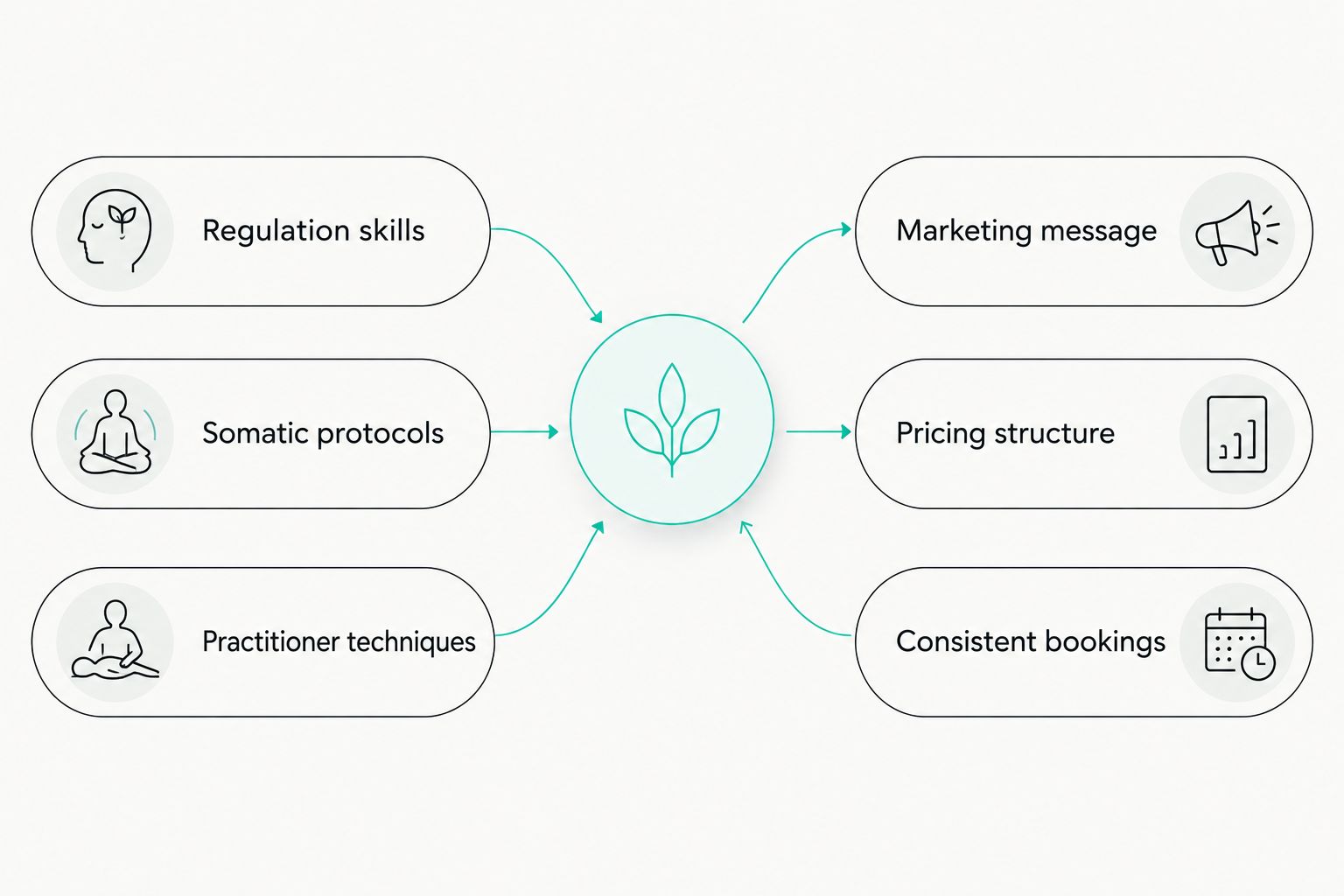
That gap is exactly why a well-earned credential and an empty calendar can coexist in the same year, and it's worth naming before you spend 2026 comparing curricula.
Yes, the robots helped write this. Some of the search-focused content on this site is outsourced to AI, because the message matters more than where the draft came from. For the writing that comes directly from Phil and Carolina's own keyboards, the link below goes to the source.
Read the writing that isn't AI-assisted
Essays written directly by Phil and Carolina, no drafting shortcuts.
What makes the best nervous system coaching certification
- Clinical grounding - the model traces back to a named originator (Peter Levine, Laurence Heller, Stephen Porges) rather than a repackaged trend
- Supervised practice hours - real practicum time with feedback, not just recorded lectures
- Recognition inside referral networks - therapists, doctors, and other coaches know the credential and trust it
- Format and time commitment - matches what you can actually sustain in 2026, not what looks impressive on paper
- Honesty about its limits - a program that doesn't pretend to also teach you client acquisition
Nervous system coaching certifications at a glance
| Certification | Best For | Standout Feature | Key Limitation |
|---|---|---|---|
| Somatic Experiencing Practitioner (SEP) | Deep trauma-resolution work | Three-tier training built on Peter Levine's original model | Roughly three years to full certification |
| NARM Practitioner Training | Developmental trauma and identity patterns | Combines relational and somatic work in one framework | Assumes prior clinical or coaching experience |
| Polyvagal Institute Certificate Training | Coaches who want the neuroscience fast | Direct grounding in Stephen Porges' Polyvagal Theory | Certificate, not a full practitioner credential |
| The Embody Lab Somatic Coaching Certification | Shorter, non-clinical entry point | Coaching-specific framing instead of a clinical protocol | Less recognized in strict clinical referral networks |
| The Nervous System School Practitioner Certification | Coaches building an online-first practice | Built by an active practitioner with a working online audience | Shorter track record than SE or NARM |
| Irene Lyon Practitioner Training | Pairing SE-informed method with a visible business model | SE-informed content plus a working example to study | Not a substitute for full SE credentialing |
1. Somatic Experiencing Practitioner (SEP): best nervous system coaching certification for deep trauma work
SE Practitioner training, developed from Peter Levine's original body of work, runs in three tiers, Beginning, Intermediate, and Advanced, typically completed over about three years. It trains you to track physiological states and titrate activation in real time with a client, not just describe regulation in theory.
Somatic Experiencing pros:
- Widely recognized inside trauma-informed referral networks
- Sequenced, multi-year depth instead of a single intensive
- Strong supervised practicum component
Somatic Experiencing cons:
- Three-year timeline is a real commitment against most people's runway
- Teaches nothing about client acquisition or pricing
- Cohort pacing means you can't accelerate even when you're ready
Best for: practitioners planning to work with clients carrying significant trauma history who need clinical depth behind them. Verdict: Buy.
2. NARM Practitioner Training: best nervous system coaching certification for developmental trauma and identity work
The NeuroAffective Relational Model, developed by Dr. Laurence Heller, works at the intersection of relational and somatic work, built specifically around the identity patterns that form around early developmental trauma.
NARM pros:
- Strong fit for coaches working with high-functioning adults who look fine on the outside
- Relational component fills a gap SE alone doesn't fully cover
- Respected among therapists who refer clients out
NARM cons:
- Assumes some prior clinical or coaching foundation
- Applying it inside a non-therapy coaching context is still work you have to do yourself
Best for: coaches whose clients present as accomplished but stuck in identity-level patterns rather than acute trauma symptoms. Best trauma-informed business coaches covers how to position this kind of work commercially once you're certified. Verdict: Buy for the right client base.
3. Polyvagal Institute Certificate Training: best nervous system coaching certification for a shorter science-first path
Built directly on Stephen Porges' Polyvagal Theory, the Polyvagal Institute's certificate tracks give you the ventral, sympathetic, and dorsal state framework in a shorter format than a full practitioner license.
Polyvagal Institute pros:
- Fastest credible path to a neuroscience foundation
- Content translates directly into language clients already use, like "regulation" and "safety cues"
- Lower time commitment than SE or NARM
Polyvagal Institute cons:
- A certificate, not a full practitioner credential, some referral sources expect more
- No supervised practicum depth comparable to SE
Best for: coaches who already hold a coaching or therapy credential and want polyvagal literacy layered on top. Verdict: Buy as a supplement, not a standalone credential.
4. The Embody Lab Somatic Coaching Certification: best nervous system coaching certification for a coaching-first path
Framed for coaches rather than clinicians, this program teaches somatic coaching methodology without positioning itself as a trauma-therapy credential.
The Embody Lab pros:
- Coaching language and framing instead of a clinical protocol
- Shorter time commitment than SE
- More accessible entry point without a clinical background
The Embody Lab cons:
- Less recognized inside strict clinical referral networks
- Newer entrant with less track record than SE or NARM
Best for: coaches who want somatic tools added to an existing coaching practice without becoming a trauma specialist. For the business side once you're certified, best somatic business coaching programs covers what to look for. Verdict: Hold if your clients need clinical-grade trauma work, Buy otherwise.
5. The Nervous System School Practitioner Certification: best nervous system coaching certification for an online-first practice
Built by Jessica Maguire around an active online audience, this practitioner track pairs nervous system content with a coaching model designed to run as a business from the start, not bolted on after graduation.
The Nervous System School pros:
- Built with online delivery and audience-building already in mind
- Content current with 2026 online coaching norms
- Smaller cohort feel than some legacy programs
The Nervous System School cons:
- Shorter track record than SE or NARM
- Less name recognition among clinical referral sources
Best for: coaches whose business model is entirely online and audience-driven rather than referral-driven. Verdict: Buy for online-first practitioners.
6. Irene Lyon Practitioner Training: best nervous system coaching certification for modeling a working business
Irene Lyon's training draws on SE principles and trains the online coaching format alongside them, useful for practitioners who want the nervous system content and a visible example of how to run it as an online business at the same time.
Irene Lyon pros:
- SE-informed content plus a working business model to study
- Established audience and community around the work
Irene Lyon cons:
- Not a substitute for full SE Practitioner credentialing if a client base specifically requires it
- Watching someone else's business model still leaves you to build your own version
Best for: coaches who learn best by studying a working example rather than theory alone. Verdict: Buy if you want the modeled-business angle, Hold if you specifically need SE certification for referrals.
How I ranked these
I ranked these six certifications on five things: clinical grounding, supervised practice hours, recognition inside referral networks, time-to-credential, and whether the program pretends to teach a business model it doesn't actually cover. None of them fully close that last gap in 2026. No certification does. That's a different kind of work entirely.
Which nervous system coaching certification should you choose?
If you're building toward serious trauma work, Somatic Experiencing Practitioner training is still the deepest, most recognized path in 2026, three-year timeline and all. If your ideal client is already successful but stuck in an identity pattern, NARM Practitioner Training fits closer. If you already hold a credential and want the neuroscience layered on without another multi-year commitment, take the Polyvagal Institute route.
None of these certifications will build your client pipeline, price your offer, or explain why a fully embodied nervous system practitioner can still have an empty calendar. Strategy, marketing, and nervous system work for people done fragmenting themselves to succeed is the whole reason Carolina and I built Sacred Business Flow. If the certification list above feels solved but the income question doesn't, that's the gap worth looking at next.
FAQ
What's the best nervous system coaching certification in 2026?
Somatic Experiencing Practitioner training is the strongest overall pick for 2026 on clinical depth and referral recognition. NARM Practitioner Training and Polyvagal Institute's certificate track are better fits for narrower use cases like developmental trauma work or a shorter science-first path.
Is Somatic Experiencing Practitioner training worth the three-year commitment?
It's worth it if you plan to work with clients carrying significant trauma history and want the clinical depth and referral recognition that come with it. If you want a shorter path, Polyvagal Institute or The Embody Lab fit better.
What's the difference between NARM and Somatic Experiencing?
NARM focuses on developmental trauma and the identity patterns that form around it, blending relational and somatic work. Somatic Experiencing focuses more directly on tracking and titrating physiological activation in session.
Do I need a certification to call myself a nervous system coach?
No certification is legally required to use the title, but referral networks and clients increasingly ask what training backs your work. A recognized credential like SE or NARM makes that conversation easier.
How much does nervous system coaching certification cost?
Cost varies by program, tier, and whether you choose an in-person or online format. Check current pricing directly with each training since tiers and formats change year to year.
Can I build a full-time practice with just a certification?
A certification builds your skill set, not your client pipeline. Practitioners who build a full-time practice pair the credential with a clear offer, pricing, and a way to get consistently booked.
Is Polyvagal Institute training a full certification?
Polyvagal Institute offers certificate-level training grounded in Stephen Porges' Polyvagal Theory, not a full practitioner license like Somatic Experiencing. Some referral sources will want a more extensive credential alongside it.
What's the difference between a nervous system coach and a somatic coach?
The terms overlap heavily in practice. Nervous system coaching tends to emphasize regulation and physiological state, while somatic coaching often centers on body-based awareness more broadly, but many practitioners use the terms interchangeably.
One last thing
The credential rarely determines income, the structure around it does. Practitioners with a single certificate have outearned people three years into an SE track, because they built the offer and the schedule first and the credential second. The Sacred Business Manifesto Part 1 goes further into that fragmentation pattern, a body of knowledge doesn't automatically become a body of clients.